Bhutan Offloads $22M in Bitcoin as Mining Costs Surge: Institutional Eyes Shift to High-Yield L2s

bitcoinistPublished on 2026-02-05Last updated on 2026-02-05

Abstract

Bhutan's sovereign wealth fund, Druk Holding & Investments, sold 367 BTC ($22M) on Binance, signaling mining sector stress due to rising operational costs and compressed hash prices. This sell-off highlights the profitability squeeze for miners, even state-backed entities. Meanwhile, institutional capital is rotating into high-yield Bitcoin Layer 2 solutions like Bitcoin Hyper ($HYPER), which leverages Solana's Virtual Machine for scalability and programmable smart contracts. $HYPER has raised over $31M in its presale, with significant whale accumulation, and offers 68% staking rewards, positioning it as a hedge against Bitcoin's volatility and mining inefficiencies.

Sovereign volatility is back. On-chain data confirms that a wallet linked to the Royal Government of Bhutan, managed by Druk Holding & Investments, recently deposited 367 $BTC to Binance. That movement, valued at approximately $22M, isn’t an isolated event. It’s a symptom of a brutal squeeze in the mining sector.
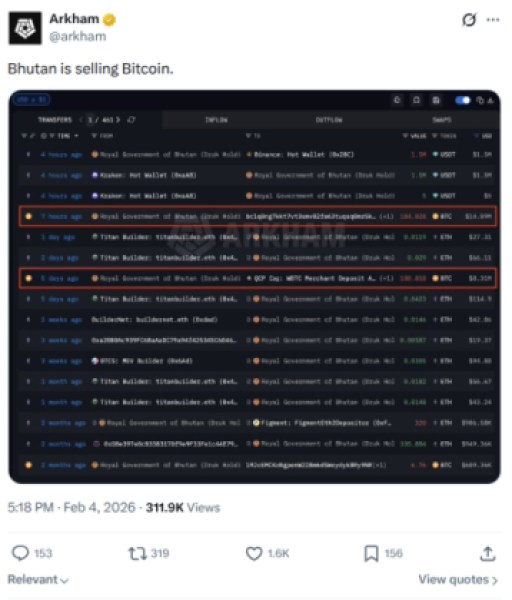
With Bitcoin’s hash price compressing and operational expenditures (OpEx) for industrial miners climbing, even state-backed entities are liquidating reserves to keep their balance sheets healthy.

The market reaction? Mixed. While a $22M sell wall is absorbable in today’s high-volume environment, the signal is undeniably bearish for short-term Layer 1 price action. It highlights the growing tension between network security costs and miner profitability.

But smart money rarely sits on its hands. As capital rotates out of stagnant spot positions, sophisticated investors are hunting for yield in the emerging Bitcoin Layer 2 ecosystem, a sector designed to solve the scalability issues currently choking the main chain.

This rotation is visible in the flows toward infrastructure projects, unlocking Bitcoin’s dormant capital. Leading the pack is Bitcoin Hyper ($HYPER), a protocol using the Solana Virtual Machine (SVM) to bring high-speed execution to the Bitcoin network.

Bitcoin Hyper ($HYPER) Brings SVM Speeds To The Oldest Blockchain

Bitcoin has a utility problem. While it remains the pristine collateral of the crypto world, let’s be honest, it’s sluggish. Transactions crawl, fees spike during congestion, and programmable smart contracts are virtually non-existent on the main chain. Bitcoin Hyper ($HYPER) tackles this by grafting the Solana Virtual Machine (SVM) directly onto the network as a Layer 2 solution.
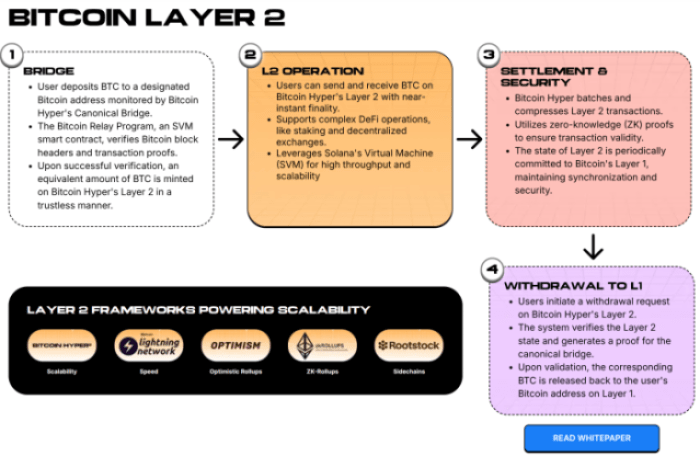
This architecture allows Bitcoin Hyper to process transactions with Solana-grade speeds while anchoring security to Bitcoin’s Layer 1. For developers, this opens the door to building DeFi apps, NFT platforms, and gaming dApps using Rust, all within the Bitcoin ecosystem.

Bitcoin Hyper uses a decentralized Canonical Bridge to ensure trustless $BTC transfers, effectively turning static Bitcoin into a productive asset.

That matters for adoption. By modifying SPL-compatible tokens for L2 execution, Bitcoin Hyper creates a high-speed payment and DeFi environment that Bitcoin has historically lacked. The protocol operates on a modular framework: Bitcoin L1 handles settlement, while the SVM L2 handles real-time execution.

This separation of concerns allows a single trusted sequencer to manage throughput without compromising the underlying security guarantees of the Bitcoin network.

LEARN MORE ON THE OFFICIAL $HYPER PRESALE PAGE

Whales Accumulate As Smart Money Front-Runs The L2 Narrative

While sovereign miners like Bhutan sell to cover costs, a different class of investor is aggressively accumulating early-stage infrastructure. The data surrounding the Bitcoin Hyper presale suggests serious institutional confidence. According to official figures, the project has already raised over $31M.


This liquidity injection isn’t just retail money. Etherscan records show that whales are also in on the action, with one wallet scooping up $500K’s worth of $HYPER. This data point, large singular buys rather than thousands of micro-transactions, indicates that high-net-worth individuals are positioning themselves before the token hits public exchanges.

With the current token price sitting at $0.0136751 and staking rewards at 68%, these entities are securing positions at a valuation that anticipates major future utility. Our experts also predict $HYPER doing well, possibly making it to $0.32 by the end of 2026. If that happens and you’d invested today, it’s an ROI of 2240%

The incentive structure supports the long game, too. Bitcoin Hyper offers high APY staking immediately after the Token Generation Event (TGE). Notably, the protocol enforces a 7-day vesting period for presale stakers. This mechanism (often overlooked by retail flippers) is designed to prevent immediate post-launch dumping, stabilizing the price floor while rewarding those who participate in governance.

For investors watching Bhutan sell L1 assets, rotating into a yield-bearing L2 represents a hedge against mining-induced volatility.

GET YOUR $HYPER ON ITS OFFICIAL PRESALE PAGE

This article is for informational purposes only and does not constitute financial advice. Cryptocurrencies are high-risk assets. The mention of specific dates, such as January 15, 2026, reflects data provided by the project source. Always conduct your own due diligence before investing.

Related Questions

QWhy did the Royal Government of Bhutan deposit 367 BTC to Binance, according to the article?

AThe Royal Government of Bhutan, managed by Druk Holding & Investments, deposited the Bitcoin to liquidate reserves due to a brutal squeeze in the mining sector, where rising operational expenditures (OpEx) and a compressing hash price are putting pressure on miners' profitability, forcing even state-backed entities to sell to maintain healthy balance sheets.

QWhat is Bitcoin Hyper ($HYPER) and how does it aim to solve Bitcoin's utility problem?

ABitcoin Hyper ($HYPER) is a Layer 2 protocol that grafts the Solana Virtual Machine (SVM) onto the Bitcoin network. It aims to solve Bitcoin's sluggish transaction speeds, high fees, and lack of programmable smart contracts by enabling high-speed execution for DeFi apps, NFT platforms, and gaming dApps using Rust, all while anchoring security to Bitcoin's Layer 1.

QWhat evidence does the article provide to suggest institutional confidence in the Bitcoin Hyper ($HYPER) project?

AThe article states that the project has raised over $31M in its presale and cites Etherscan records showing large singular buys, such as one wallet acquiring $500K worth of $HYPER, indicating accumulation by high-net-worth individuals and whales rather than retail micro-transactions.

QWhat is the predicted price for $HYPER by the end of 2026 according to the 'experts' mentioned in the article, and what potential ROI does that represent?

AThe experts predict that $HYPER could reach $0.32 by the end of 2026. With the current presale price at $0.0136751, this represents a potential return on investment (ROI) of 2240%.

QWhat mechanism does Bitcoin Hyper use to prevent immediate post-launch dumping and stabilize the price floor after its Token Generation Event (TGE)?

ABitcoin Hyper enforces a 7-day vesting period for presale stakers. This mechanism is designed to prevent immediate selling (dumping) after the launch, thereby stabilizing the price floor and rewarding participants who are involved in long-term governance.

Related Reads

Trading

Spot
Futures

Hot Articles

What is $BITCOIN

DIGITAL GOLD ($BITCOIN): A Comprehensive Analysis Introduction to DIGITAL GOLD ($BITCOIN) DIGITAL GOLD ($BITCOIN) is a blockchain-based project operating on the Solana network, which aims to combine the characteristics of traditional precious metals with the innovation of decentralized technologies. While it shares a name with Bitcoin, often referred to as “digital gold” due to its perception as a store of value, DIGITAL GOLD is a separate token designed to create a unique ecosystem within the Web3 landscape. Its goal is to position itself as a viable alternative digital asset, although specifics regarding its applications and functionalities are still developing. What is DIGITAL GOLD ($BITCOIN)? DIGITAL GOLD ($BITCOIN) is a cryptocurrency token explicitly designed for use on the Solana blockchain. In contrast to Bitcoin, which provides a widely recognized value storage role, this token appears to focus on broader applications and characteristics. Notable aspects include: Blockchain Infrastructure: The token is built on the Solana blockchain, known for its capacity to handle high-speed and low-cost transactions. Supply Dynamics: DIGITAL GOLD has a maximum supply capped at 100 quadrillion tokens (100P $BITCOIN), although details regarding its circulating supply are currently undisclosed. Utility: While precise functionalities are not explicitly outlined, there are indications that the token could be utilized for various applications, potentially involving decentralized applications (dApps) or asset tokenization strategies. Who is the Creator of DIGITAL GOLD ($BITCOIN)? At present, the identity of the creators and development team behind DIGITAL GOLD ($BITCOIN) remains unknown. This situation is typical among many innovative projects within the blockchain space, particularly those aligning with decentralized finance and meme coin phenomena. While such anonymity may foster a community-driven culture, it intensifies concerns about governance and accountability. Who are the Investors of DIGITAL GOLD ($BITCOIN)? The available information indicates that DIGITAL GOLD ($BITCOIN) does not have any known institutional backers or prominent venture capital investments. The project seems to operate on a peer-to-peer model focused on community support and adoption rather than traditional funding routes. Its activity and liquidity are primarily situated on decentralized exchanges (DEXs), such as PumpSwap, rather than established centralized trading platforms, further highlighting its grassroots approach. How DIGITAL GOLD ($BITCOIN) Works The operational mechanics of DIGITAL GOLD ($BITCOIN) can be elaborated on based on its blockchain design and network attributes: Consensus Mechanism: By leveraging Solana’s unique proof-of-history (PoH) combined with a proof-of-stake (PoS) model, the project ensures efficient transaction validation contributing to the network's high performance. Tokenomics: While specific deflationary mechanisms have not been extensively detailed, the vast maximum token supply implies that it may cater to microtransactions or niche use cases that are still to be defined. Interoperability: There exists the potential for integration with Solana’s broader ecosystem, including various decentralized finance (DeFi) platforms. However, the details regarding specific integrations remain unspecified. Timeline of Key Events Here is a timeline that highlights significant milestones concerning DIGITAL GOLD ($BITCOIN): 2023: The initial deployment of the token occurs on the Solana blockchain, marked by its contract address. 2024: DIGITAL GOLD gains visibility as it becomes available for trading on decentralized exchanges like PumpSwap, allowing users to trade it against SOL. 2025: The project witnesses sporadic trading activity and potential interest in community-led engagements, although no noteworthy partnerships or technical advancements have been documented as of yet. Critical Analysis Strengths Scalability: The underlying Solana infrastructure supports high transaction volumes, which could enhance the utility of $BITCOIN in various transaction scenarios. Accessibility: The potential low trading price per token could attract retail investors, facilitating wider participation due to fractional ownership opportunities. Risks Lack of Transparency: The absence of publicly known backers, developers, or an audit process may yield skepticism regarding the project's sustainability and trustworthiness. Market Volatility: The trading activity is heavily reliant on speculative behavior, which can result in significant price volatility and uncertainty for investors. Conclusion DIGITAL GOLD ($BITCOIN) emerges as an intriguing yet ambiguous project within the rapidly evolving Solana ecosystem. While it attempts to leverage the “digital gold” narrative, its departure from Bitcoin's established role as a store of value underscores the need for a clearer differentiation of its intended utility and governance structure. Future acceptance and adoption will likely depend on addressing the current opacity and defining its operational and economic strategies more explicitly. Note: This report encompasses synthesised information available as of October 2023, and developments may have transpired beyond the research period.

363 Total ViewsPublished 2025.05.13Updated 2025.05.13

What is $BITCOIN

Discussions

Welcome to the HTX Community. Here, you can stay informed about the latest platform developments and gain access to professional market insights. Users' opinions on the price of BTC (BTC) are presented below.

活动图片